

Better decisions at the intersection of technology, markets, and people.
JMS Innovation & Strategy helps organizations evaluate technologies and opportunities, understand customers and markets, address human and organizational factors, and determine what the evidence supports doing next.
Explore How JMS Can Help
When the path forward isn't obvious.
A promising technology or market opportunity can raise more questions than answers.
Is there a meaningful market? Which applications should we pursue? What do customers actually need? What could prevent adoption? Are we solving the right problem? Does the organization have what it needs to move forward?
These questions rarely belong to a single discipline.
JMS brings together technology, market and customer insight, human factors, organizational context, and business strategy to develop a clearer picture of the opportunity — and the choices surrounding it.
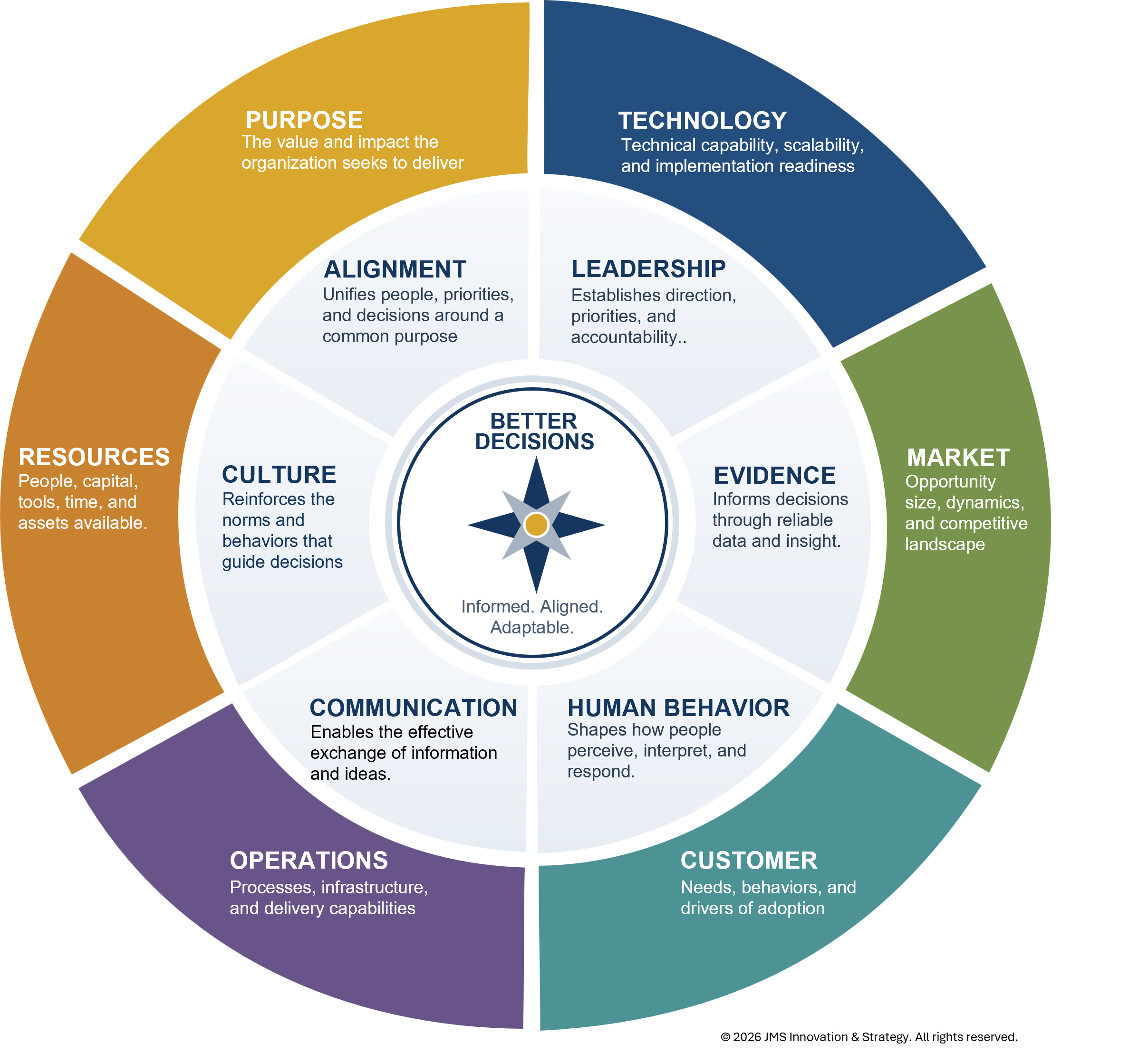
Integrated Perspective.
Technology doesn't succeed in isolation.
Commercial and strategic outcomes are shaped by the interaction between technical capability, customers and users, market dynamics, business considerations, and the organization itself.
JMS examines these factors together to support better strategic decision-making.
Services.
Technology & Commercialization
Connect technical capability with commercial opportunity.
Evaluate technologies, applications, markets, and commercialization pathways to understand where an opportunity may exist and what it may take to pursue it.
Examples: technology assessment, application prioritization, commercialization strategy, market-entry considerations, positioning, partnership and licensing pathways.
Market & Customer Insight
Understand the market beyond the numbers.
Develop evidence about customers, users, competitors, alternatives, market dynamics, and unmet needs to test assumptions and inform strategic choices.
Examples: customer discovery, stakeholder interviews, market assessment, competitive analysis, voice-of-customer research, opportunity prioritization.
Human Factors & Sociotechnical Systems
Understand how people, technology, and organizations interact.
Examine the human and system factors that influence performance, usability, implementation, decision-making, and adoption.
Examples: human-factors analysis, task and workflow analysis, user and stakeholder research, adoption barriers, human-system interaction, and sociotechnical systems analysis.
Strategic Decision Support
Turn evidence into clearer choices.
Bring technical, market, human, organizational, and commercial evidence together to evaluate alternatives, challenge assumptions, identify uncertainty, and determine appropriate next steps.
Examples: opportunity assessment, strategic alternatives, assumption testing, investment decision support, prioritization, and independent strategic assessment
Organizational Issues.
You may be asking...
We have a promising technology. Is there really a market for it?
We see several possible applications. Which should we pursue?
Customers say they're interested. Why aren't they adopting?
Our technical and commercial teams see the opportunity differently. What are we missing?
The technology works. Why isn't implementation working?
Are organizational constraints undermining the strategy?
What do customers, users, and other stakeholders actually need?
What evidence do we need before making the next investment?
Should we keep going, change direction, partner, license, or stop?
These are rarely just technology, market, or people problems. Understanding how the pieces interact often changes the decision.
Human Factors is about more than usability.
Human factors examines how people interact with technologies, tasks, environments, information, and organizations.
Depending on the problem, JMS may examine individual users and workflows, decision-making and adoption behavior, organizational factors, or the broader sociotechnical system in which people and technology operate.
The level of analysis is matched to the problem and the decisions that need to be made.
Start with the question, not the answer.
JMS engagements begin by understanding the decision that needs to be made and the evidence needed to make it well.
That may require examining the technology, talking with customers or users, understanding the market, evaluating human and organizational factors, or combining several forms of analysis.
The method follows the problem. Not the other way around.
A perspective built across disciplines.
Complex technology and commercialization decisions rarely fit neatly within engineering, market research, human factors, or business strategy.
JMS Innovation & Strategy was built around working across those boundaries.
Drawing on experience spanning engineering, psychology and human factors, technology, market development, and business strategy, JMS examines opportunities from multiple perspectives and connects the evidence needed to make better decisions.
Experience applied to real decisions.
1) Technology → New Market
Evaluated potential applications, customers, and commercialization pathways for an emerging technical capability.
2) Customer → Strategic Change
Used primary customer and stakeholder research to challenge assumptions and redirect market or product strategy.
3) Human Factors → System Understanding
Applied human-factors analysis to understand interactions among people, technology, tasks, and organizational conditions.
4) Evidence → Investment Decision
Integrated technical, market, customer, and commercial evidence to support a consequential go/no-go or prioritization decision.